AI in JavaScript/TypeScript: What You Can and Can’t Do
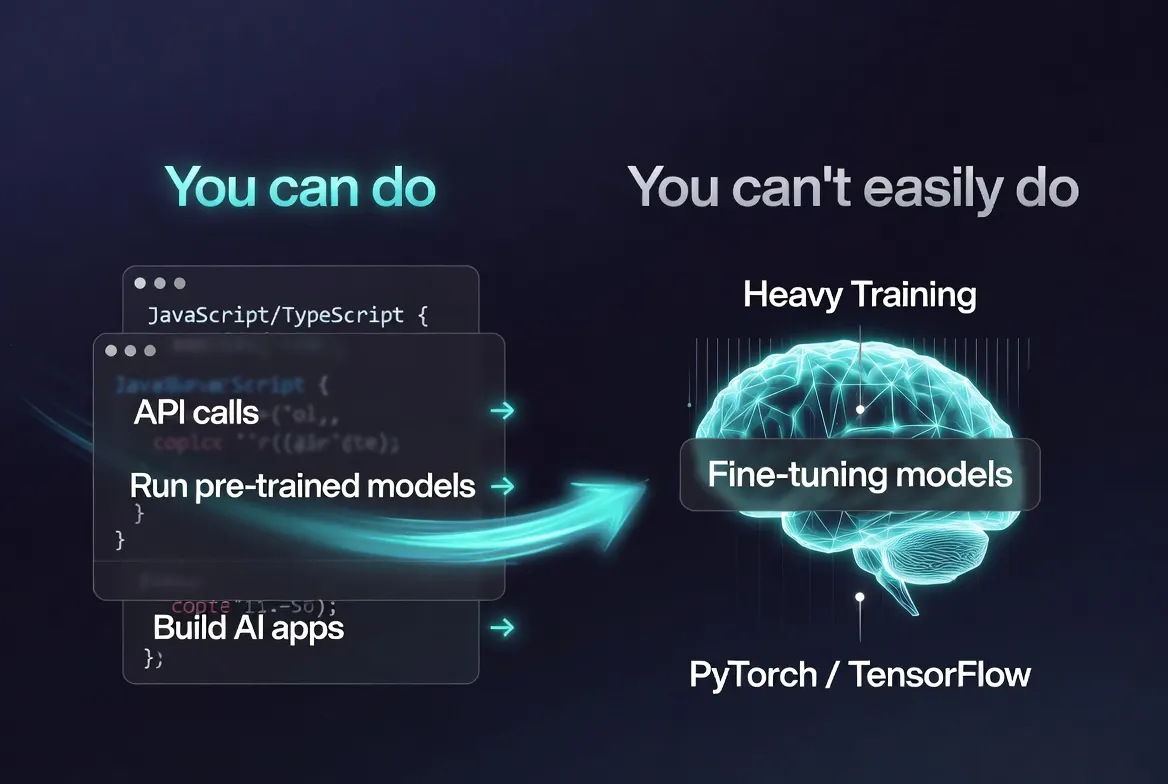
The AI side of JS/TS is considerably weaker compared to Python, but the good news is, it’s better than most other programming languages (with the exception of Rust and Julia, which are also growing in the AI space).
You actually have three ways to handle AI operations in your JS/TS environment:
- Use APIs directly from OpenAI, Anthropic, Google, etc. No issues here. You get full access to the most powerful models (GPT-4, Claude, Gemini) with a simple HTTP call or SDK. This is how 90%+ of production apps use AI today.
- Use Hugging Face Inference API and choose a model from a vast catalog of pre-trained models. Still works great. The heavy lifting happens on Hugging Face’s servers, not on your machine.
- Run models locally using Transformers.js (by Hugging Face) or TensorFlow.js (by Google). This lets you run pre-trained AI models directly in Node.js or even in the browser, without any API calls.
The first two options work perfectly fine. You can build powerful AI-powered applications without ever touching Python.
The issue starts with the third option, and more specifically, when you want to go beyond just using models. If you want to train your own model, fine-tune an existing one, or do serious ML research, no JavaScript tool can compete with Python’s native ecosystem:
- PyTorch (by Meta), the most popular ML framework, used by most AI researchers
- TensorFlow (by Google), the other major framework
These tools are written in C++ and CUDA under the hood, with Python as their primary interface. That’s actually why Python is fast for AI. Python itself is slow, but it’s just the steering wheel. The engine underneath is highly optimized C++.
We do have TensorFlow.js and Transformers.js, but they come with real limitations: no GPU acceleration via CUDA, limited model support, and you can’t practically train large models. TensorFlow.js can handle small tasks like training an image classifier, but anything beyond that hits a wall.
Why did Python win AI?
Not because it’s a fast language. It’s actually one of the slowest. It won because of its ecosystem: NumPy, Pandas, Scikit-learn, PyTorch, TensorFlow, Jupyter Notebooks. And because academia adopted it first, meaning all research papers publish their code in Python. The entire AI world was built around it.
So here’s the bottom line:
Python is the brain of AI. TypeScript is the app that talks to the brain.
If you want to train, fine-tune, or develop your own AI models, you need to learn Python, there’s no way around it. But if your goal is to integrate AI into your applications, calling APIs, running pre-trained models, building AI-powered features, JavaScript/TypeScript is absolutely enough, and arguably better for building the actual product around it.
Most JS/TS developers don’t need Python at all, because companies like OpenAI, Anthropic, and Google provide APIs that abstract away all the complexity. You don’t need to understand PyTorch to build an AI-powered app. You just need to know how to call an API.
Now, if you’re curious how steps 2 and 3 look in practice with TypeScript, check out my GitHub repos: huggingface for Hugging Face API integrations and local-model-integration for running models locally with Transformers.js.
Keep building, Keep learning!