How Does ChatGPT Actually Understand You? The Simple Truth Behind Pre-Training and Fine-Tuning.
You know how tools like ChatGPT or Grok can answer almost anything, write code, or tell stories and it feels almost… human?
It feels complex. But if you strip everything down, it’s surprisingly simple.
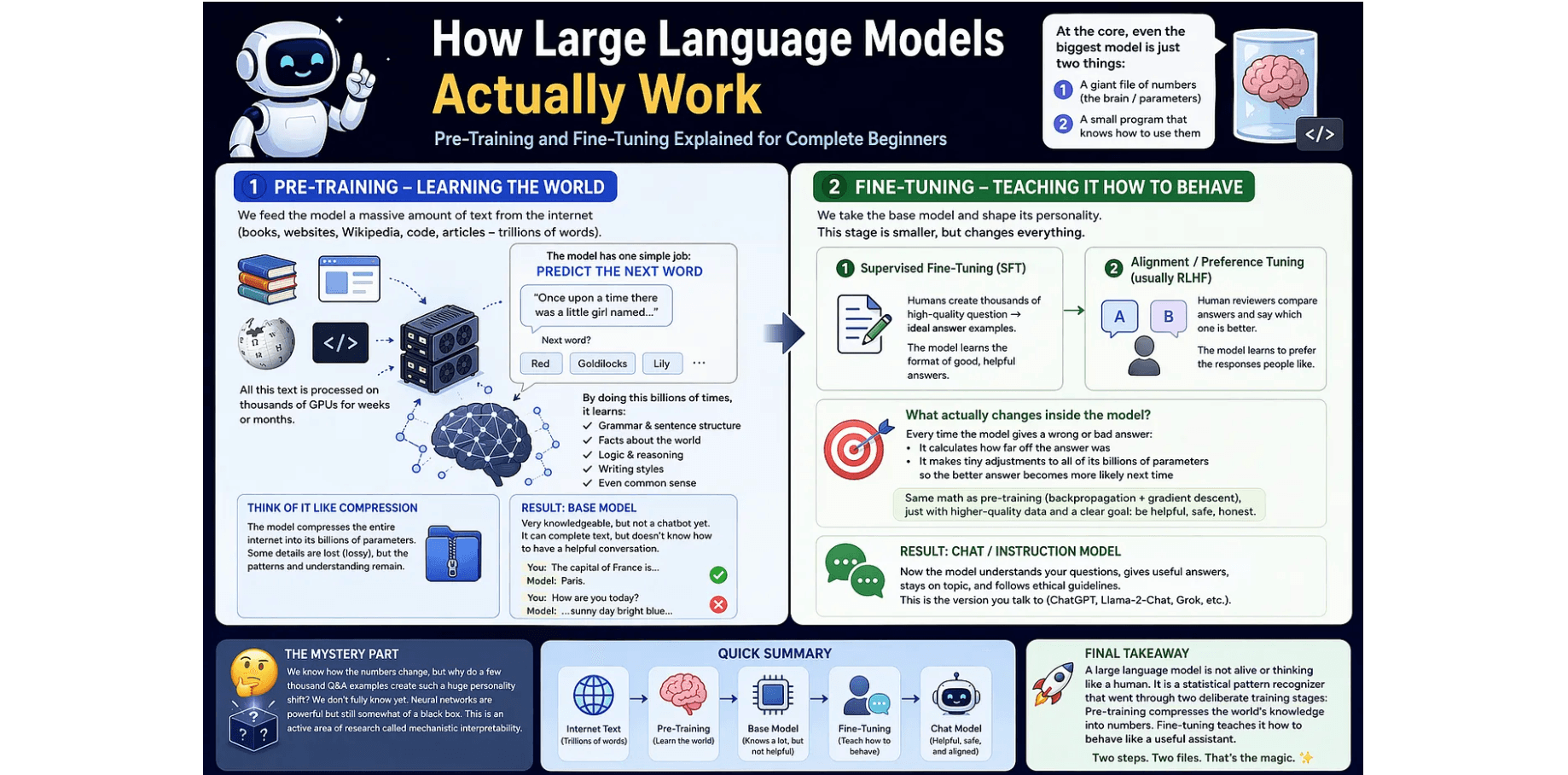
At the core, it’s just:
- One huge file of numbers (these are the “brain” called parameters)
- One small program that knows how to use those numbers
That’s it. No hidden consciousness. No secret intelligence.

So the real question is:How do those numbers become so smart?
It happens in two big stages: Pre-training and Fine-tuning.
Press enter or click to view image in full size

Step 1: Pre-training — “Learning the world”
This is where the model learns almost everything it knows about the world.
What happens?
- The AI company collects tons of text from the internet (books, websites, Wikipedia, code, articles, roughly 2 trillion words for a model like Llama 2).
- They feed all this text into thousands of powerful GPUs (graphics cards) running nonstop for weeks or even months.
- The only job the model has is: predict the next word.
Press enter or click to view image in full size

That’s literally it.
For example:“Once upon a time there was a little girl named…”
It tries to guess the next word.
It gets it wrong → adjusts itselfIt gets it right → reinforces that pattern
And it repeats this billions of times.
The magic that happens inside:
While doing this simple task, it accidentally learns:
- Grammar
- Facts
- Reasoning
- Writing styles
- Even some level of common sense
Not because we told it to but because it had to in order to get better at predicting text.
You can think of pre-training as extremely smart lossy compression (like a super-advanced ZIP file).
Imagine you have the entire internet. You can’t store it as-is (it would be too big). Instead, the model zips all that knowledge into its 70 billion parameters. Some details are lost (it is lossy), but the patterns and understanding are kept.
Result after pre-training = Base Model
This base model is incredibly knowledgeable but not a chatbot yet.
If you give it “The capital of France is…”, it will probably continue with “Paris” because that is the most likely next text. But if you ask it “How are you today?” it won’t know how to reply like a helpful assistant — it will just keep writing random text. It only knows how to complete sentences.
Step 2: Fine-tuning — “Teaching it how to behave”
Now we take the base model and shape its personality.
This stage is much smaller and faster than pre-training.
Step-by-step:
- Supervised Fine-Tuning (SFT) Humans create thousands of perfect Question to Ideal Answer examples. These are not random Reddit comments — they follow strict rules: be helpful, honest, safe, clear, etc. The model is trained on these examples so it learns the format of good answers.
- Alignment or Preference Tuning (often called RLHF) Human reviewers look at two possible answers and say “Answer A is better than Answer B.” The model learns to prefer the kind of responses people like.
Press enter or click to view image in full size

*What actually changes inside the model?
Every time the model gives a wrong or bad answer, the training process does something very precise:
- It calculates how far off the answer was.
- It makes tiny adjustments to every single parameter (all 70 billion of them) so that the better answer becomes slightly more likely next time.
This is the same math used in pre-training, just with much higher-quality data and a clear goal: “Be a helpful, safe, and honest assistant.”
*Result after fine-tuning = Chat or Instruction Model
This is the version you actually talk to (Llama-2–70B-Chat, GPT-4, Grok, etc.).
The same underlying brain (parameters) is now shaped to:
- Understand your questions
- Give useful answers
- Stay on topic
- Follow ethical guidelines
The Mystery Part: Why Does It Feel Like Magic?
You might be thinking: “We know how the numbers change… but why do a few thousand Q and A examples create such a huge personality change?”
That part is still a bit mysterious.
We understand the math perfectly (it is called backpropagation plus gradient descent). But we don’t yet fully understand why tiny changes across billions of parameters create the dramatic shift from text completer to thoughtful assistant.
Neural networks are still somewhat of a black box, very powerful, but hard to read like normal computer code. This is an active area of research called mechanistic interpretability.

Quick Summary Table
Press enter or click to view image in full size

Final Takeaway
A large language model is not alive or thinking like a human. It is a statistical pattern recognizer that went through two deliberate training stages:
- Pre-training compresses the world’s knowledge into numbers.
- Fine-tuning teaches it how to behave like a useful assistant.
Everything you love about modern AI (the helpfulness, the creativity, the safety rails) comes from these two steps.
The next time you chat with Grok, ChatGPT, or any other LLM, remember: behind the friendly answers are just two files, one huge list of numbers and one small program, carefully trained in two stages to feel almost human.
👉 Inspired by concepts from Prompt Engineering Bootcamp (Working With AI & LLMs) by Scott Kerr (Zero To Mastery).